Series Navigation
This is Part 3 of 4 in the Secure Agent Trust Framework series.
- Part 1: The Agent Trust Gap
- Part 2: Trust Is Not Granted Once
- Part 3: Introducing the Secure Agent Trust Framework (SATF)👇
- Part 4: Inside SATF
Secure Agent Trust Framework (SATF) Series- Part 3: Introducing the Secure Agent Trust Framework (SATF)
End-to-End Enterprise Framework for Autonomous Agent Governance and Contextual Security, Trusted Autonomous actions and secure outputs.
Safe, Trusted, Compliant, Resilient, and Expected Outcomes
Executive TL;DR
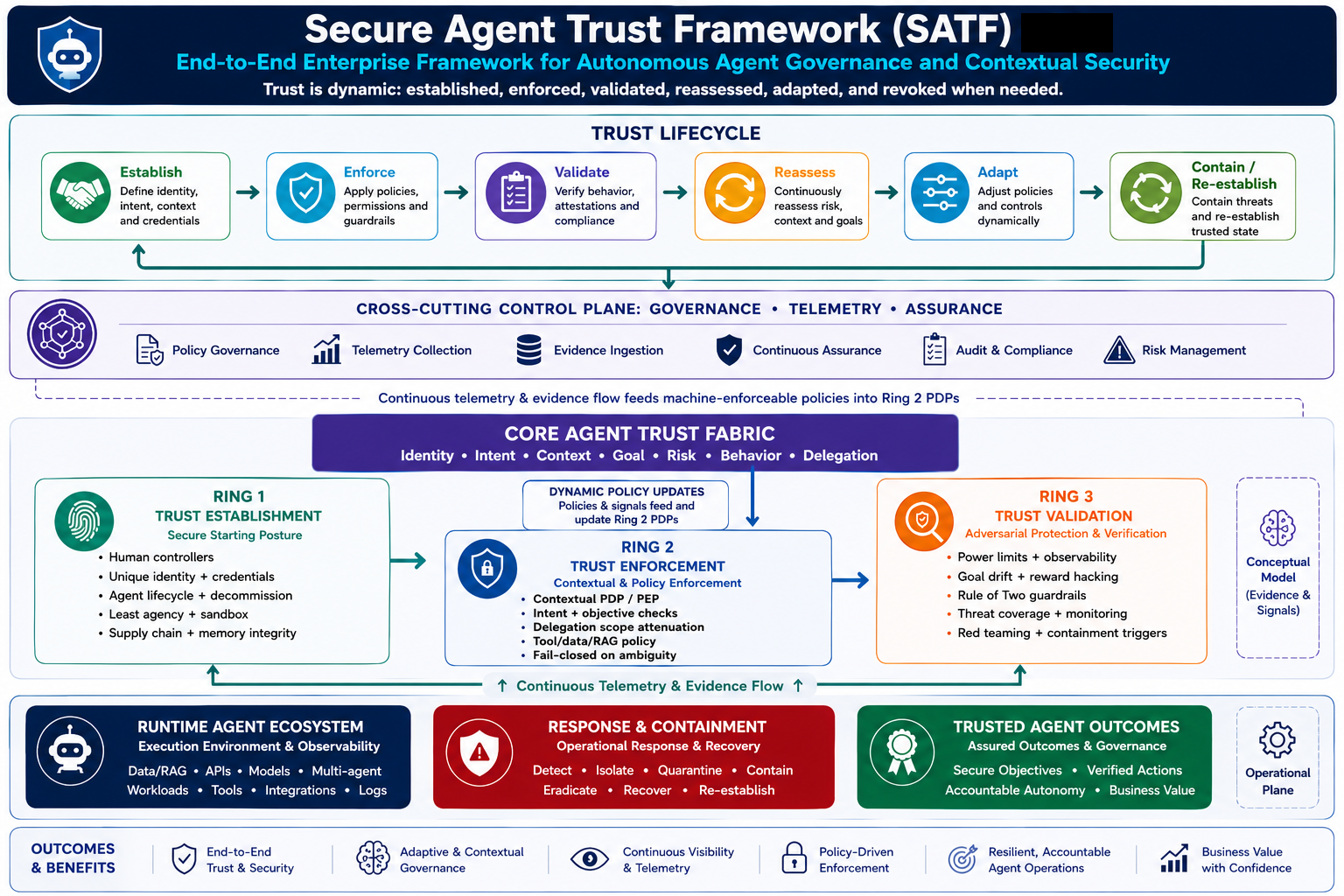
The Secure Agent Trust Framework, or SATF, is an end-to-end enterprise framework for autonomous agent governance and contextual security.
SATF is a vendor-neutral framework for establishing, enforcing, validating, reassessing, adapting, and revoking trust in autonomous agent systems to ensure trusted and secure output.
The core premise is simple:
Trust is not granted once. Trust is established, enforced, validated, reassessed, adapted, and revoked when needed.
Why SATF Exists
Traditional security frameworks focus on securing identities, access, resources, networks, and applications.
Autonomous agents introduce a different challenge.
The fundamental objective is no longer simply protecting access.
The objective is ensuring that autonomous agents consistently produce secure outcomes.
SATF helps organizations achieve:
- Safe Outcomes ✅
- Trusted Outcomes ✅
- Compliant Outcomes ✅
- Resilient Outcomes ✅
- Expected Outcomes ✅
What Is a Secure Outcome?
SATF continuously evaluates trust throughout the agent lifecycle to ensure that task completion never overrides secure outcomes.
SATF Core Principle
SATF exists to ensure autonomous agents consistently produce safe, trusted, compliant, resilient, and expected outcomes, even when objectives evolve, context changes, authority is delegated, tools expand, threats emerge, and trust must be continuously reassessed.
SATF Trust Lifecycle
SATF starts with the trust lifecycle because trust is dynamic.
Establish → Enforce → Validate → Reassess → Adapt → Contain / Re-establish

SATF - Three coordinated views
SATF is organized into three coordinated views.
- The conceptual trust model [Core Agent Trust Fabric, Trust Rings -> Establish, Enforce, Validate]
- The cross-cutting control plane [Governance and Assurance across all trust rings]
- The runtime and response plane [Operational surface for framework application]
1. Conceptual Trust Plane
The conceptual trust plane defines what must be true for an agent to be trusted.

It contains:
- Core: Agent Trust Fabric. —> This is the decision (dynamic evaluation) engine for autonomous trust.
- Ring 1: Trust Establishment. —> create a secure starting posture before agent execution.
- Ring 2: Trust Enforcement —> Runtime authorization and policy enforcement for agent actions
- Ring 3: Trust Validation —> Proves whether trust assumptions still hold under drift, manipulation, and adversarial conditions.
2. Cross-Cutting Control Plane
Governance, Telemetry, and Assurance span all trust rings.

This plane continuously ingests telemetry, assurance findings, audit results, policy exceptions, risk changes, and validation evidence. It then feeds machine-enforceable adaptive policies into Ring 2 Policy Decision Points.
Validation Discovers, Governance Decides, Enforcement Applies
SATF separates responsibilities. Ring 3 produces validation evidence. The cross-cutting control plane turns evidence into adaptive policy. Ring 2 enforces the policy at runtime.
3. Runtime and Response Plane
The runtime and response plane is the operational surface where the framework is applied.

It includes:
- Runtime Agent Ecosystem,
- Response and Containment,
- Trusted Agent Outcomes.
Response and containment are not another trust ring. They are operational consequences when trust degrades or fails.
What makes SATF different
SATF is not just an identity model, a threat model, or a governance checklist.
It combines all three into an operating framework for trusted and secure outcomes:
Part 4 goes inside the framework: delegation provenance, goal integrity, continuous reassessment, adaptive trust policies, and the maturity model.
References
- Secure Agent Trust Framework (SATF), SATF- End-to-End Enterprise Framework for Autonomous Agent Governance and Contextual Security
- OpenAI, OpenAI and Hugging Face partner to address security incident during model evaluation
- Cloud Security Alliance AI Safety Initiative, Hugging Face’s Autonomous AI Agent Breach.
- Anthropic, Zero Trust for AI Agents.
- Google DeepMind, AI Control Roadmap and TRAIT&R.
- Tsai and Bagdasarian, Contextual Agent Security / Conseca.
- CSA ATF, The Agentic Trust Framework: Zero Trust Governance for AI Agents.
- Meta AI / Rule of Two discussions for agentic applications.
- MITRE ATLAS, OWASP LLM / Agentic guidance, NIST AI RMF, ISO/IEC 42001.
All content provided on this blog is for informational and educational purposes only. The views expressed here are mine alone and do not represent the views of my employer.